
Firmer contours. Better skin quality. No surgery.
Aesthetic medicine is evolving — and so is the way we think about ageing skin.
The focus is increasingly shifting away from changing the face and towards improving the quality, structure and definition of the skin itself.
XERF® is one of the newer technologies entering this space. The non-invasive radiofrequency treatment uses controlled heat to target different depths within the skin and underlying tissue. The aim is a firmer, more defined appearance without needles or surgery.
For Dr. Timm Golüke, XERF was not a technology discovered overnight. He first encountered the treatment in Korea, a market that has long been at the forefront of innovative aesthetic dermatology.
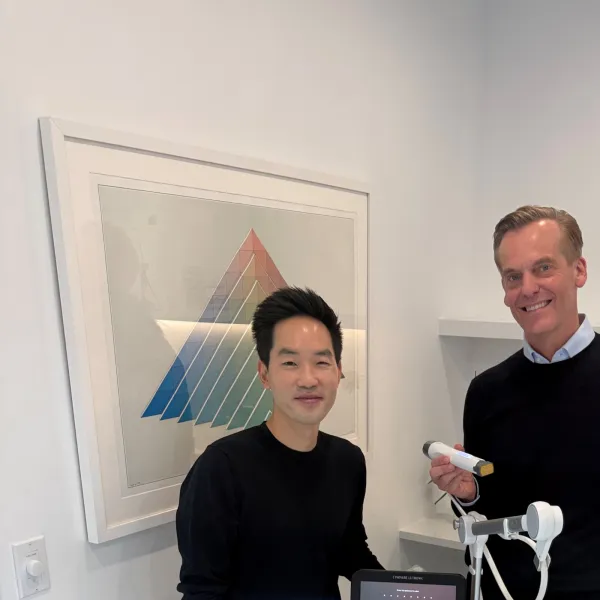
Last summer, he explored the technology further during a visit to New York, where he met with Dr. David Kim to exchange views on current treatment concepts and the practical use of XERF.
For Dr. Golüke, this kind of international exchange is an important part of assessing new technologies: looking beyond the launch story and understanding how a treatment performs in real clinical practice.
XERF has now arrived in Munich.
What is behind XERF®?
Radiofrequency is by no means new to aesthetic dermatology. What makes XERF interesting is the way the technology is engineered.
The system combines two radiofrequency frequencies — 6.78 MHz and 2 MHz — within a treatment pulse. According to the manufacturer, this is designed to address different tissue depths. An integrated cooling system is used to cool the skin surface during treatment.
The underlying principle of radiofrequency is well established: radiofrequency energy is converted into heat within tissue. Controlled thermal exposure can influence collagen-rich tissue and processes associated with collagen remodelling.
The extent of the clinical effect, however, can vary from person to person, and the long-term performance of newer radiofrequency systems continues to be investigated.
Technology meets evidence
With any new beauty-tech innovation, it is worth looking beyond the headlines.
Early clinical studies of XERF have reported promising findings relating to skin tightening and a range of skin-quality parameters. At the same time, the evidence base is still relatively young. The published studies to date involve comparatively small patient groups and provide encouraging initial clinical data, but they do not yet establish long-term outcomes over many years or demonstrate that XERF is superior to every other established treatment.
That distinction matters.
The technology itself is clearly defined. The first clinical data are interesting. Further research will determine how durable the results are and where XERF ultimately sits within the broader landscape of energy-based treatments.
Who is XERF® for?
XERF may be particularly interesting for people looking for firmer, more defined skin without opting for surgery.
Potential treatment areas include the face, jawline and neck, particularly where there is mild to moderate loss of skin firmness.
The idea is not to create a new face.
No added volume. No dramatic change in facial proportions. No attempt to erase expression.
Instead, the focus is on supporting a firmer, more refined appearance while keeping the individuality of the face intact.
A treatment with timing
One of the interesting aspects of radiofrequency treatments is that the full effect does not necessarily reveal itself immediately.
The controlled thermal stimulus may lead to changes that develop over time. This is why clinical studies assess outcomes not only directly after treatment, but also weeks and months later.
Whether one treatment is appropriate or a series is recommended depends on the individual's skin condition, tissue characteristics and aesthetic goals.
There is no universal treatment schedule — and there shouldn't be.
The new aesthetic: less changing, more preserving
Aesthetic medicine is moving towards a more considered approach.
Less transformation. More refinement.
Rather than trying to dramatically alter the face, the emphasis is increasingly on skin quality, firmness, structure and definition.
XERF fits naturally into this shift.
It is not a replacement for surgery, nor is it a universal solution for every form of skin ageing. Instead, it represents another option within a modern, personalised approach to aesthetic dermatology — particularly for those looking for visible tightening without changing the character of their face.
XERF® in Munich
With XERF, Dr. Timm Golüke is expanding his treatment portfolio with another contemporary radiofrequency technology.
His exposure to the treatment in Korea, followed by an exchange with Dr. David Kim in New York, has provided an international perspective on how the technology is being used in clinical practice. Combined with the early clinical data currently available, XERF represents an interesting addition to the aesthetic dermatology landscape.
Ultimately, the technology should never dictate the treatment.
The face should.
Every XERF treatment therefore begins with an individual dermatological assessment to determine whether the technology is appropriate and what treatment approach makes the most sense.
Because the best treatment is not necessarily the newest one.
It is the one that is right for your skin — and for the result you want to achieve.


